About our Policies & Procedures
(Child Safety & Risk Management)
At Shilleena’s Dance Academy, child safety and wellbeing come first. These Policies & Procedures explain what you can expect from our studio and teachers, what we expect from families and students, and how we manage safety, risk, privacy, and feedback.
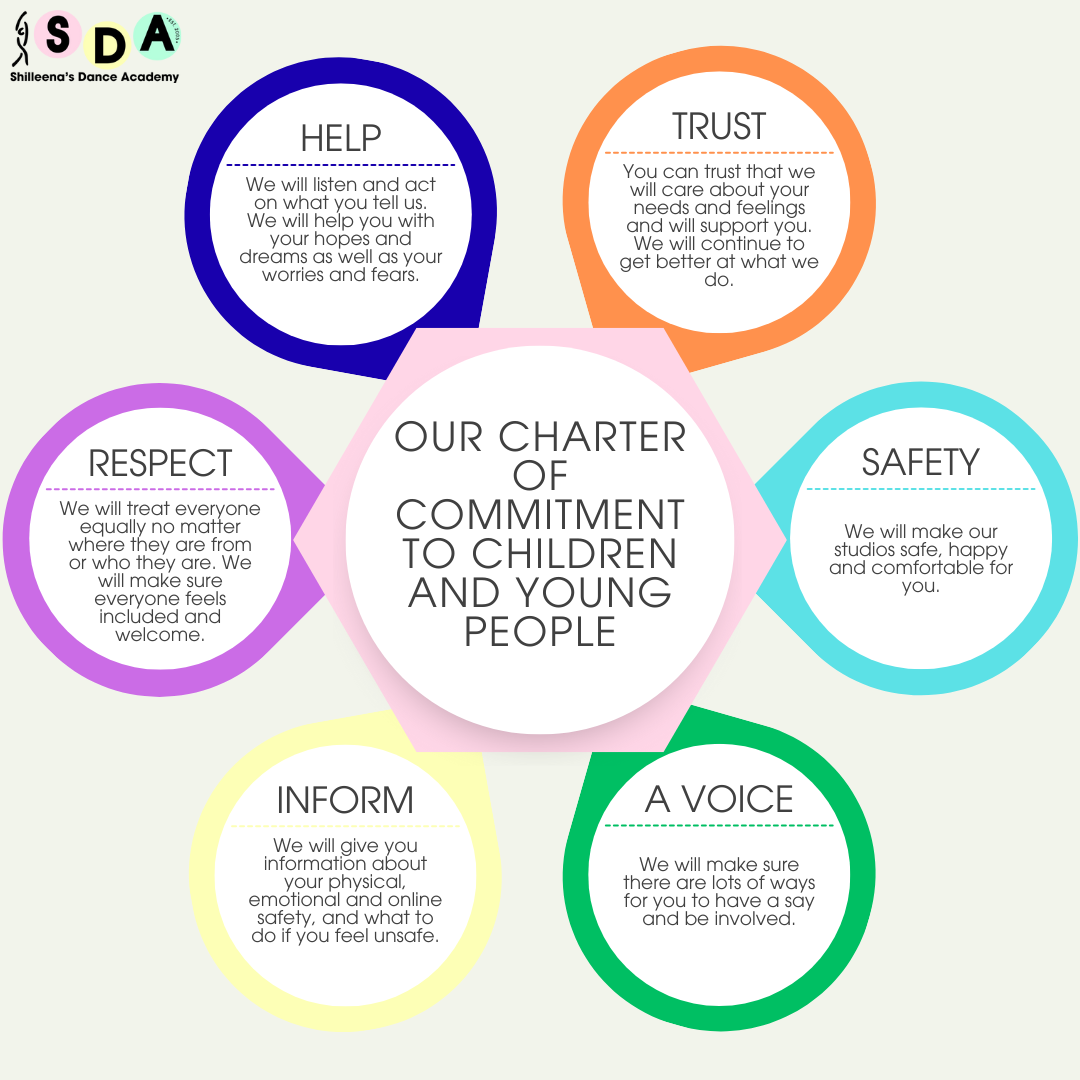
Charter of Commitment
Shilleena’s Dance Academy aims to:
- provide a high standard of tuition in ballet, jazz, tap, creative dance, contemporary, lyrical, cabaret, street jazz and acrobatics.
- nurture a love of dance.
- provide encouragement and support to the individual.
- provide a well-rounded dance training program.
- provide a fun and creative class environment.
Shilleena’s Dance Academy is committed to the safety and wellbeing of all children attending this dance school. Shilleena’s Dance Academy is
committed to providing services to children and young people to assist them to fulfil the aims listed above.
POLICY CONTENTS
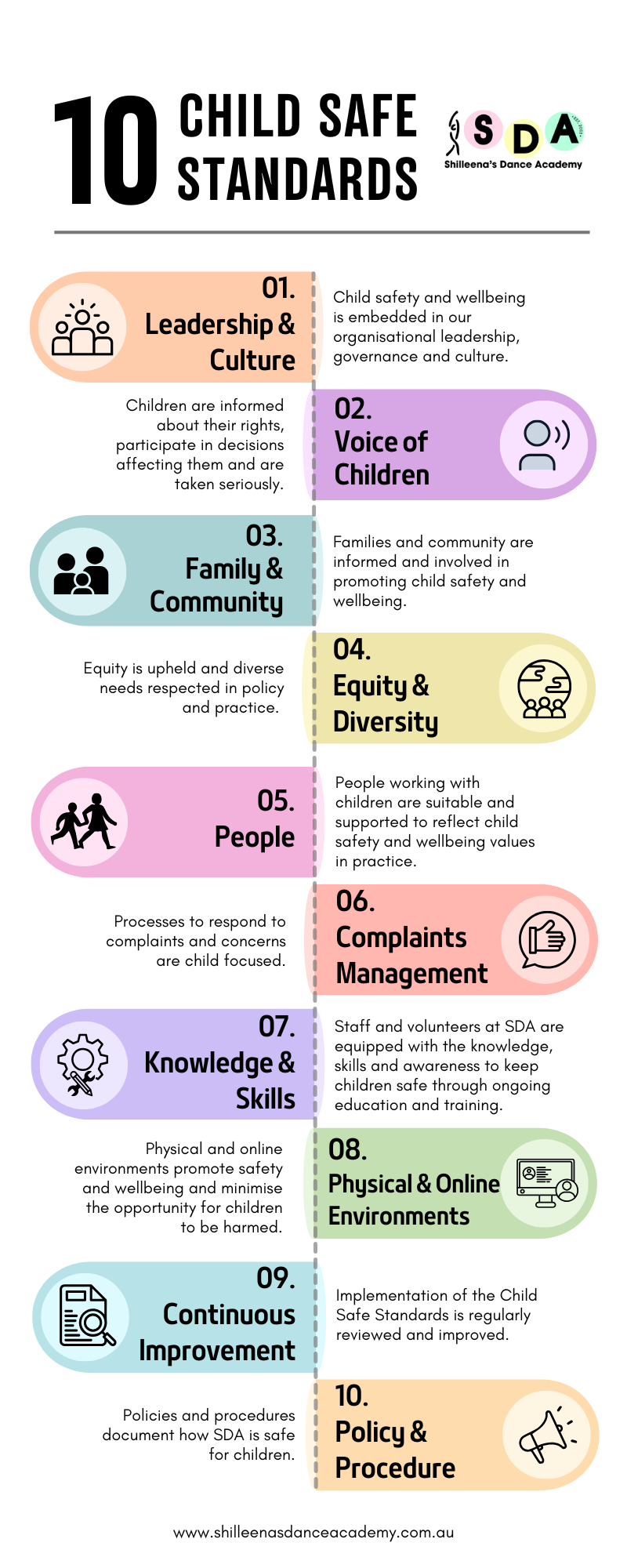
The 10 Child Safe Standards
What You Can Expect From Our Studio
At Shilleena’s Dance Academy (SDA) we are committed to ensuring our Charter of Commitment is at the forefront of everything we do. Our Studio Code of Ethics ensures every student sees the benefit of their implementation.
- We will make sure SDA and its staff can provide any services claimed.
- We will employ teaching staff with the experience, knowledge or qualifications required for the range of levels and techniques being taught. Student teachers will be trained and supervised to ensure the school’s teaching standards are maintained.
- We will provide assessment procedures and will make sure students and parents receive, or have access to, advice when necessary.
- We will conform to sound business practice and provide an efficient fee system.
- We will make sure class sizes are suitable for the levels and techniques being taught. Students in each class will be of a similar age or standard.
-
We will make sure the studios have:
- minimum safety and space requirements
- suitable lighting and ventilation
- suitable flooring, with a safe surface designed and constructed to minimise the risk of injury
- mirrors and barres installed appropriately.
- We will ensure that all employees/volunteers responsible for students are unaffected by the use of substances which may compromise the appropriate supervision of children.
- We will gain consent from parents or carers before photographing or videoing any child.
- We will gain consent from parents or carers before communicating by phone or email with any child.
- We will not support bullying or harassment by anyone to anyone, including among children.
- We will ensure that no visitors or outsiders have contact with the children.
- We will notify parents/carers if classes are unable to be conducted.
The Director of SDA has the following rights
- To cease teaching a child or young person who is consistently non-compliant or obstructive, in which case the parent or carer will be contacted immediately.
- To respect the rights of others to be taught and to learn.
- To raise any concerns with a child and/or parent or carer.
- To expect that any child/parent or carer will make concerns known as soon as they arise so that a resolution can occur as quickly as possible.
- To allow only a parent or carer, guardian or another nominated person to pick up a child from our studio.
- To cease teaching any student until overdue fees have been paid in full.
- To report disclosures and suspicions of harm.
What You Can Expect From Our Teachers
Teachers at SDA adhere to Our Teacher’s Code of Ethics to ensure that every student receives the tuition, respect and safe environment expected of our organisation.
- Individual teachers will use effective and flexible teaching skills to create a productive learning environment. Individual teachers will:
- strive to communicate a love of dance
- show professional attitudes, including punctuality, reliability and responsible care of students
- strive to develop self-discipline and self-motivation in the students
- encourage and support the individual in the class situation
- present general concepts of movement as well as those of a particular dance style.
- Individual teachers will recognise the role of dance in the development of the whole person. They will also seek to recognise and develop each student’s potential, whether it lies in dance or related fields, and offer appropriate guidance for further progress.
- Individual teachers will try to recognise physical variations, modifying their teaching and seeking medical advice when necessary. The teaching and choreography must be anatomically safe, and teachers must be prepared to deal with medical emergencies.
- Individual teachers will strive to develop in the students an appreciation of the characteristic style of each specific technique taught.
- Individual teachers will take responsibility for seeking more knowledge in all aspects of their work.
- Individual teachers and student teachers will hold current Working With Children Blue Cards.
- Individual teachers will use fair and inclusive teaching practices recognising cultural, gender and age differences and different physical and learning abilities.
- Individual teachers will model positive attitudes by:
- showing their love for dance with energy and enthusiasm,
- setting clear goals and expectations,
- using language that shows respect for students and staff, and
- teach safe dance principles; non-judgmental attitudes; positive body image; punctuality, planning and preparation.
Teachers at SDA will be encouraged to develop appropriate relationships with children and young people under their tutelage. We encourage an open and friendly environment that communicates freely and inclusively. Friendships with students, including those on social media, are at the discretion of the teacher. It is the teacher’s responsibility to ensure that appropriate security and privacy measures are in place for the posting of content. It is the student’s responsibility to ensure that appropriate professional boundaries are respected. At all times, both teachers and students must follow the guidelines for age limitations specified by the social media platform.
What SDA Expects From Our Community
The SDA community will
- foster mutual respect between teachers, children and young people regardless of cultural identity and cultural practices/behaviour,
- understand children and young people, their ages, stages of development, special circumstances and special needs,
- use language which is age/stage appropriate, clear, non-threatening and non-sexual,
- use physical contact only where it is completely necessary during the course of business-related duties and where permission from the child has been gained in that instance,
- willingly listen to a child or young person’s concerns/issues,
- willingly use a variety of methods to motivate a child,
- openly listen to parent/child suggestions, feedback and complaints, and
- employ corrective practices which are not punitive, humiliating or aggressive.
Children also have responsibilities
They will demonstrate:
- a willingness to learn,
- a willingness to listen and receive instructions,
- respect for other children, young people and adults both inside and outside of the studio,
- safe and appropriate behaviour while waiting for lessons to commence, or while waiting to be collected by parents or carers, and
- responsibility for appropriate behaviour and reporting inappropriate behaviour and unsafe situations or harm.
Parents and caregivers should
- accept feedback regarding their child’s progress,
- help children to set realistic goals based on their individual ability and experience,
- focus on, and encourage, the child’s efforts and performance. Do not focus on winning,
- teach children that an honest effort is as important as a victory, so that the results of each examination or performance are accepted without too much disappointment,
- remember that children learn best by example. Applaud good performances by all the performers,
- if you disagree with an examiner, adjudicator or critic, raise the issue through the appropriate channels rather than question the official's judgment in public,
- drop off and pick up children and young people in a timely fashion, leaving the child in their teacher’s care only,
- provide the necessary clothing and footwear relevant to the dance style as requested,
- alert the teacher/Director to any concerns as soon as they arise, when possible,
- give constructive feedback on SDA’s policies and procedures,
- provide information to teachers regarding medication/injuries/life events that may affect their child’s performance in class,
- be aware that personal information will be treated confidentially and privacy will be respected,
- remember that their child participates in activities for their own enjoyment, not the parents or carers, and
- support all efforts to remove verbal and physical abuse from dance activities.
Injury Prevention & Risk Management
As a member of Ausdance Queensland, SDA employs injury prevention and management strategies, in accordance with The Australian Guidelines for Teaching Dance. We will:
- emphasise and apply the importance of correct warm-up and cool-down procedures in all classes.
- provide access to water and explain the importance of being hydrated before, during and after exercise.
- make sure students dress safely for the dance style/genre.
- manage space use to reduce accidents.
- encourage individuals to take responsibility for their safety and the safety of others.
- structure each class so that exercises progress.
- identify and adapt potentially dangerous exercises and choreography to suit the age, physical development and level of control in each class.
- adapt exercises and choreography where students show obvious signs of fatigue.
- structure classes and rehearsals to avoid excessive repetition and overuse of body parts by varying the intensity, volume and activity in a class.
Teachers at SDA encourage students to accept reasonable challenges and to take risks with teacher support. Students should also support each other in challenging or risk-taking activities. No student will be penalised for an unwillingness or inability to take risks they are uncomfortable with.
All teachers at SDA undertake First Aid, CPR and Mental Health First Aid training.
In the case of a child requiring medical treatment or in the case of a medical emergency, parents and carers accept that teachers at SDA may be required to provide first aid to students as required. This may include calling an ambulance if necessary. All efforts will be made to contact parents or caregivers in this instance. If it is deemed necessary, SDA will arrange for the student to receive medical or surgical treatment. Any costs which may be incurred for the medical treatment, ambulance transport and medication will be the responsibility of the parent or carer.
To the maximum extent permitted by applicable law, in no event shall Shilleena’s Dance Academy or its teachers/contractors/volunteers be liable for any special, incidental, indirect, or consequential damages whatsoever including, but not limited to, damages for loss of profits, loss of data or other information, for business interruption, for personal injury, loss of privacy arising out of or in any way related to the use of or inability to use our services, third-party software and/or third-party hardware used with our services, or otherwise in connection with any provision our services.
Some states do not allow the exclusion of implied warranties or limitation of liability for incidental or consequential damages, which means that some of the above limitations may not apply. In these states, each party's liability will be limited to the greatest extent permitted by law.
A Risk Register for general business activities is used to plan for the likelihood of unsafe situations and determine the necessary action if that situation were to eventuate. SDA’s Risk Register is available on request.
Use of Technology and Media Authorisation
The use of cameras, smartphones, computers, mobile phones, video cameras and other electronic devices by students and parents is strictly prohibited in the studio. The use of these devices will result in their confiscation by the teacher for the duration of the class.
The exception of this rule is during Parent Watching Week when parent or carers may photograph and/or video their child during their lesson. Please be mindful that other parents or carers may not want their child photographed, and you must gain permission before posting content on social media if any child other than your own is visible.
Teachers and students (at the teacher’s discretion) are permitted to record dancers for demonstration and/or choreographic purposes to assist with practicing at home. SDA uses private WhatsApp groups for each class to share exercises and routines or general class information. Inclusion in these groups is not compulsory and is at the parent or carer’s discretion. WhatsApp groups are moderated by the studio Director.
At the commencement of your enrolment at SDA, students and their parents or carers will be asked to sign a Media Authorisation and Release form. SDA acknowledges that not all families are comfortable with images of themselves/their child to be used for promotional purposes and we respect your right to privacy. A copy of this form will be emailed to you upon enrollment.
Risk Management Plans for Special Events
Where a special event takes place, parents or carers will be provided with the relevant information regarding:
- the purpose of the event and its intended outcome for your child,
- the venue,
- the organiser’s risk management strategy where possible/relevant (if the event is to take place at a venue other than my place of business),
- any potential risks unique to the special event and how they will be prevented,
- location of venue and its reputation for conducting special events,
- bathroom locations,
- estimated attendance numbers,
- supervision arrangements, and
- transportation arrangements.
Physical Interaction
There may be instances where physical contact is necessary between a student and a teacher. Examples include injury prevention and management, particularly during acrobatics classes, to demonstrate a skill or for instructional purposes as part of an activity, or to assist with toileting of young children if required. Prior to initiating physical contact, the student will be told how and why contact is needed.
Inappropriate physical contact will not be tolerated and will be reported, including, but not limited to, violent or aggressive behaviour such as hitting, kicking, slapping or pushing, kissing, or touching of a sexual nature.
Reporting Guidelines and Directions for Handling Disclosures and Suspicions of Harm
If confronted with a disclosure of harm from a child or young person, the Director will respond professionally and in the best interests of the child or young person subjected to the alleged harm. The Director will ensure that children know it is their right to always feel safe and take anything a child or young person says seriously and follow up their concerns.
Reporting of disclosures and suspicions of harm will be made in accordance with procedures recommended by the Commission for Children and Young People and Child Guardian.
In summary, SDA’s Director and teaching staff will:
- document the disclosure or suspicion of harm in a non-judgemental and accurate manner as soon as possible.
- notify the Queensland Police Service and Department of Families if it is suspected that a child is being harmed at home.
- notify the Queensland Police Service and Department of Families if it is suspected that a child is being harmed outside the home.
- notify parents or carers in the first instance if it is suspected that a child is self-harming. Notify the Department of Families if appropriate.
- keep any reports or documentation on disclosures of harm confidential and secure, with access strictly limited and on a ‘need to know’ basis.
Strategies for Communication and Support
A copy of current Policies and Procedures including the risk management strategy and child safety policy will be displayed at SDA, and an electronic copy will be provided to all parents or carers.
Parents or carers will be notified of any changes and will be provided annually with a new copy of SDA’s Policies and Procedures.
Breaches of SDA’s Policies and Procedures by parents, carers or children may result in:
- changes to future class arrangements,
- termination of further tuition, and/or
- notification to external authorities if a breach is considered critical.
Procedure for Feedback and Concerns
If you have feedback, a concern or complaint, please contact the Director as soon as possible so a response can be forthcoming as quickly as possible. Arrange a time convenient to both parties when there is sufficient time to discuss any issues.
Email, telephone or online communication is encouraged. Ensure only relevant parties are present when a complaint is being discussed. If possible, issues should not be discussed within hearing range of the child or young person.
Privacy Policy
Please refer to our Privacy Policy page
COVID-Safe Plan
SDA operates under an industry-approved COVID-safe plan.
Conclusion
This policy page may change from time to time and is available on our website.
This policy page was last reviewed and updated on 13 February 2026.
In developing these Policies and Procedures, I have used several risk management-related resources offered by the Commission for Children and Young People and Child Guardian and Ausdance Australia. These resources can be viewed at Blue Card Services, www.qfcc.qld.gov.au and Home » Ausdance | Dance Advocacy.
If you have any concerns about these Policies and Procedures, please contact Director Shilleena Collins on 0439 763 082 to discuss.
This strategy will be reviewed regularly (minimum annually).
Date of review: 13 February 2026